


You’ve seen the stats: you have less than three seconds to impress a new visitor before they bounce. But in 2026, the stakes are even higher. With AI search tools and Google’s Core Web Vitals acting as the digital gatekeepers, a slow website isn't just an inconvenience - it's a silent sales killer for any professional web design project.
Every millisecond your site spends loading is a moment a potential client in Chester or Manchester is clicking away to a competitor. If your site feels sluggish, it’s rarely just 'one big thing' causing the lag. Usually, it’s a combination of hidden technical bottlenecks that are strangling your conversion rates and pushing your search rankings into the abyss. Speed is only half the battle - your site also needs to be built for a mobile-first world.
The good news? Once you know where to look, these issues are fixable. Here is the 2026 roadmap to getting your speed - and your sales - back on track.
1. Unoptimised 'Legacy' Images
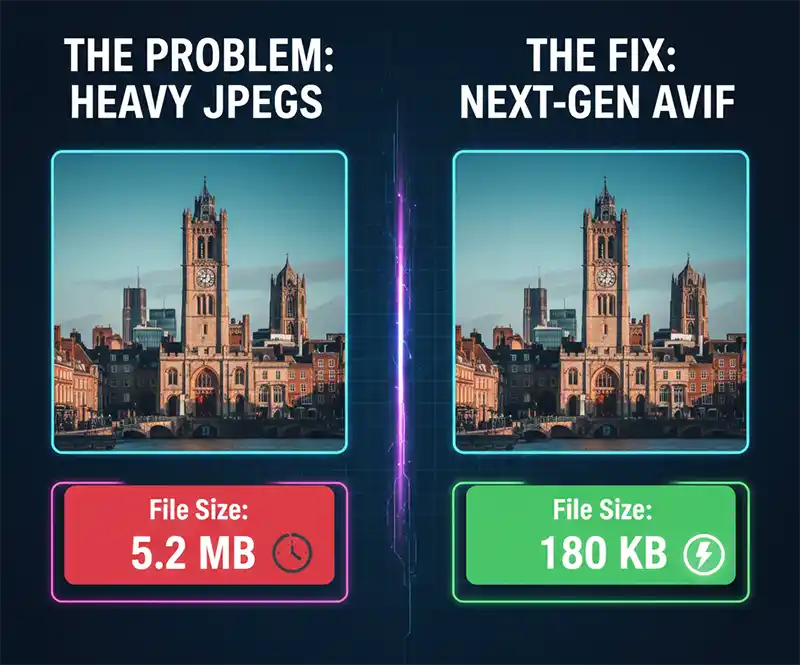
Many sites still use heavy JPEGs or PNGs. In 2026, Google expects Next-Gen formats like WebP or AVIF, which offer superior compression without losing quality.
-
The Killer: High-resolution photos that look great but weigh 5MB each.
-
The Fix: Convert all assets to AVIF and implement 'Lazy Loading' so images only load as the user scrolls.
2. Third-Party Script Bloat
Every 'helpful' tool you add - chatbots, tracking pixels (Meta/LinkedIn), and heatmaps - drags your speed down.
-
The Killer: Scripts that 'block' the rest of the page from loading while they try to connect to an external server.
-
The Fix: Use 'Delay' or 'Defer' attributes so your main content loads first, and the marketing tools load last.
3. The 'Shaky Foundation' (Budget Hosting)
If you’re on a shared £5/month hosting plan, you’re sharing resources with thousands of other sites.
-
The Killer: High TTFB (Time to First Byte). If your server takes a second just to 'wake up', no amount of code optimisation will save you.
-
The Fix: Move to a managed VPS or Cloud hosting with a Content Delivery Network (CDN) like Cloudflare to serve data from the node closest to your user.
4. Excessive Plugin & Theme 'Debt'
Old plugins or 'heavy' page builders inject massive amounts of unused CSS and JavaScript into every single page load.
-
The Killer: 'Render-blocking' code that makes the browser do heavy math for features you aren't even using.
-
The Fix: Audit your plugins quarterly. If you haven't used it in 3 months, delete it. Switch to lightweight, block-based builders.
5. Mobile Rendering Gaps
A site can be 'Fast' on a desktop but 'Fail' on mobile because of how the phone's processor handles complex layouts.
-
The Killer: Failing the INP (Interaction to Next Paint) metric - when a user taps a mobile menu and it takes a half-second to respond.
-
The Fix: Simplify mobile layouts and ensure 'Tap Targets' (buttons) are at least 44px wide so the phone doesn't have to 'guess' where the user clicked.
Is Your Site Still Dragging?
Don't let a slow website be the reason you lose your next big contract. At Codeguys, we provide high-performance web design in Manchester, Liverpool and Chester to help local businesses dominate their local search results.

No jargon, no fluff. Just a 100% transparent look at what’s slowing you down and how to fix it.



 Cookie settings